
When Mythology Meets Modernity
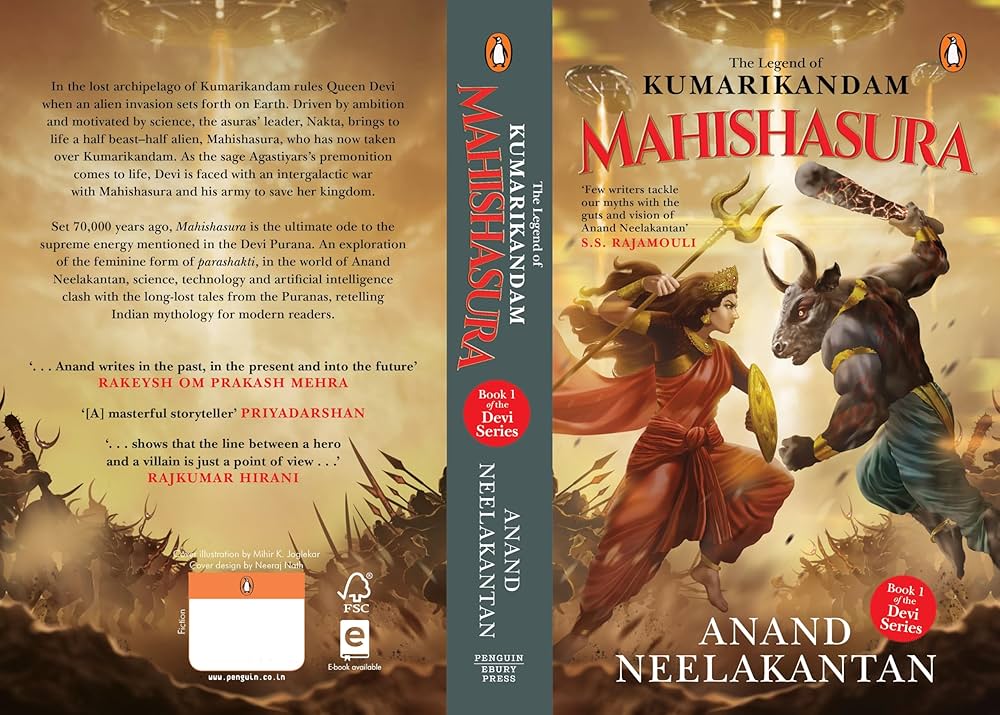
Title: Mahishasura: The Legend of Kumarikandam
Author: Anand Neelakantan
Publishers: Penguin Random House India
Genre: Mythology
Introduction
Mahishasura: The Legend of Kumarikandam, Book 1 of the Devi Series, is a mythological science fiction, set in the era when Cholas, Pandyas and Cheras ruled the South of India. The history of their dynasties and conflict for Madurai and control over the south has been narrated, but what sets the book apart, is that it blends mythology and science, telling the story of Madurai Meenakshi and Sundaresha, slaying of Mahishasura, and the eternal struggle between Devas and Asuras. There are drones, wireless communication devices, simulation boards, and online games. The book is an amalgamation of ancient, present and future.
The Plot
This intricate tale is about Devas and Asuras trying to capture ‘Shakti’, a divine feminine energy residing in Bhoomi. The story begins with both Devas and Asuras trying to annihilate each other in pursuit of Shakti, and the Asuras migrating to Bhoomi, armed with their Vimanas, futuristic weapons, masks, Sanjeevani Yantra and Gomedha crystals. Nakta, the Vijnani Asuri then scientifically creates Mahishasura, the most powerful demon of all. Meanwhile Meenakshi, the princess of Madurai, daughter of Malayadhwajan and Kanchanamala, is banished from her own kingdom, but she commands immense respect from her subjects, who later join forces to fight the Cholas who snatched the city from Meenakshi.
Why is Meenakshi protected by Shiva, his Maitrikas and Vishnu? Why does Nakta create one Bhoosura after the other, why does she ambush Meenakshi? Who wins the game, and who confronts the mighty Mahishasura? The answers for these form the crux of the story.
Analysis
Indian mythology is indeed vast and varied. The book captures a small event, the story of Shakti slaying Mahishasura, but, to the minutest detail.
Kumarikandam and Jambudweepa are supposed to be lost and imaginary islands that have been brought back to life, into a relatively known historical era of Chola reign over Madurai. Lord Shiva as Sundaresha, and Lord Vishnu meet with humans and are, in fact, a part of society. The legend of Manu and his fish has been discussed, with a human angle. There are references to Vaikuntha and Kailasa. So, somehow Anand Neelakantan succeeds in making Gods look more human and humane by mixing mythology with history.
Whether we watch mythological movies and serials, or listen to our grandparents’ fables, many aspects are usually Maya or magic. Be it the weapons (astras), time travel, curses or boons, everything has a certain amount of mythical component.
But Anand Neelakantan has provided a scientific solution to every section. For instance, the creation of Mahishasura has been depicted as a science experiment. Lord Shiva is called, the Bhootanatha. Why so? That too has an explanation. Vishnu’s mount Garuda, and Shiva’s Nandi are projected like Artificial Intelligence, large machines that do a wonderful job.
Intergalactic travel is something that happens pretty often between the three Lokas, but here, that’s all thanks to the high-speed Vimanas or drones. These are used for surveillance, security and of course, whizzing past galaxies. And they are equipped with fuel, wings, pilots and complex cockpit devices to navigate the required velocity.
This kind of amalgamation, of the most modern and futuristic technology, history and mythology. For me as a reader, this is the first.
What Works.
What I liked the most about the book is the way Anand Neelakantan treats his female characters. Meenakshi is beautiful, courageous and just. She has all the virtues of ruling a kingdom, she stands with the truth and her people, does not abandon them midway and fights for what’s fair. She is trained in martial arts and warfare, too. Sumathi, her companion, is a noble woman as well, strong, principled and courageous. Even Nakta, for that matter, is depicted as a strong-willed and super intelligent Asuri, who craves for knowledge, likes to experiment and works hard to make the Asuras strongest of all. All these women are victims of the existing patriarchy and Varna system, they are looked down upon by sages like Manu and Shukracharya, their opinions are seldom sought. Yet, they emerge winners, thanks to their determination and indomitable spirit.
Also, the Varna system and the bane of it’s unfortunate existence has been debated bravely. To make Shudras and women occupy the last position in queues, and the decision to save the Brahmins and Kshatriyas before the Shudras, in Manu’s ark are some of the many instances of the Varna system curse that has been openly talked about in the book.
That’s perhaps why, Asuras who have been shown as a highly intelligent group, way ahead of Devas in science and technology, are often treated unfair by the Holy Trinity.
Crystal mazes, complex board displays, drones and vimanas equipped with supercomputers, simulations and codes, wireless communication with a specific range, nuclear weapons, even Mahishasura’s creation, science takes the lead in the story.
The language is simple, smooth and straight, not ornate and knotty. The story switches efficiently between Meenakshi, Nakta and Saptarishis, which makes reading very captivating and non-monotonous.
I especially like the part when Meenakshi says that the progress of anything good, even science, should be within limits, or the result could be otherwise.
The ending truly amazed me, it stops at a point from where there is no looking back. You have to know what’s about to happen next.
Conclusion
Anand Neelakantan’s first book in Devi series, the story of the battle between Mahishasura and Shakti, makes for a really interesting read. Hindu mythology has so many interpretations, and this one is indeed thought-provoking, with a completely different point of view, which makes it rare and unputdownable. The pace is perfect, and the futuristic approach works in it’s favour. The narration is so effective and detailed that you could actually visualise the events, like a movie.
I would recommend the book to all readers who appreciate mythology. A different perspective, but no drastic change in the traditional account.
My Rating: 5/5