


INTRODUCTION
Digital.
The simple combination of 1 and o, bursting into a million bytes, kilobytes and gigabytes.
The latest trend, the fulcrum on which the world revolves now. And I, Prof. Preethi Warrier welcome you to this course, Digital System Design. Wherein you will learn to convert your regular numbers to just, 1s and 0s. You will enjoy studying Logic Gates and test your logic skills by designing simple adders, subtractors and multiplexers. You could design your own digital counters and registers, using a simple device known as Flip Flop. Which as the name suggests, flips and flops between 0 and 1. And what more, it has it’s own memory too.
And if you think you had too much of hardware, there is programming as well. In a special language called Verilog HDL. Which helps you to visualize the system you designed in the form of waveforms, again just Ups and Downs.
But then, there’s one question which perhaps all of you thought of. Why Digital?
All around us, we are surrounded by Analog entities.
Sound-Analog.
Light- Analog
ECG- Analog
EEG- Analog
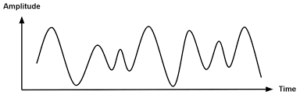
Shown above is an Analog signal
Then why are they all being converted to digital?
For the simple reason, that, Analog signals occupy every instant of time, in a continuous manner. Even the slightest noise affects their amplitude and frequency, which heavily damages the signal.
But imagine a scenario where there are only 1s and 0s. Just High and Low. Noise affects them too, but the damage is very less due to the discontinuity. The speed of transmitting 1s and 0s is far higher than sending across continuous signals.
Hence accuracy, speed and better noise free reception, make digital signals and systems the need of the hour. Today, most of the analog signals are first converted to their digital format, transmitted across the medium, received accurately, and then converted back to their original Analog format.
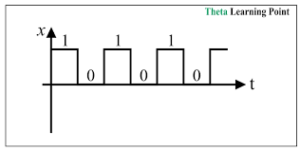
Given above is a digital signal
Our very first module, for this course will commence from the conversion of Decimal Numbers to Binary, Octal and Hexadecimal formats.
Module 2 will go a step further, where we will perform arithmetic and logical operations on 1s and 0s. Using these simple concepts, we will design binary adders and subtractors along with comparators and multiplexers.
Module 3 will explore the world of sequential circuits, where a small device called Flip Flop uses Clock frequencies to design larger circuits like counters that could go up and down from 0 to 100.
Module 4 will deal with the simulation of all these circuits in Verilog HDL Language.
My next blog to follow soon. Happy Learning.